
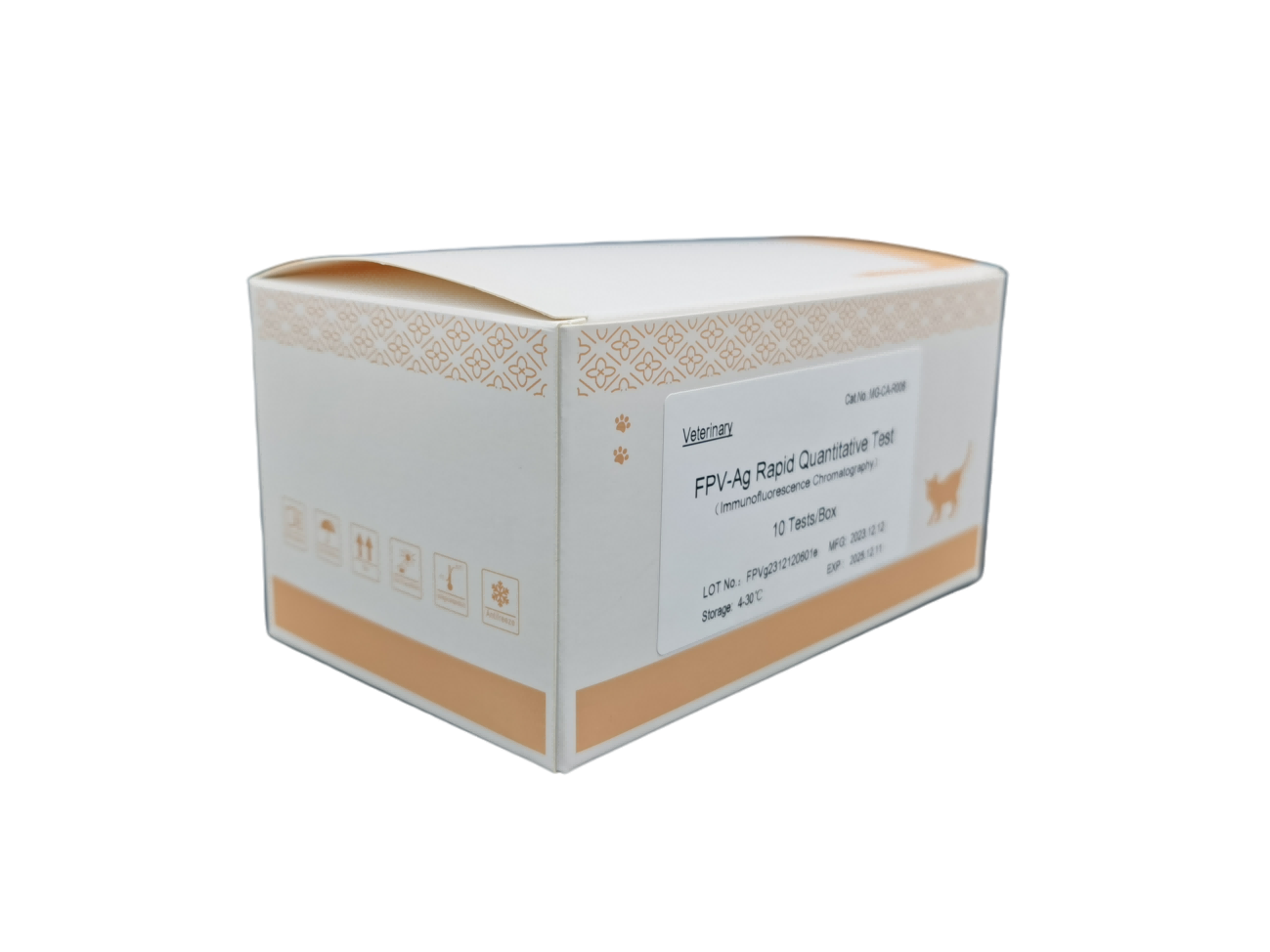
FCoV-Ag Feline Coronavirus Antigen Test Kit
Catalog No.: MG-CA-R029
Quantitative Feline Coronavirus Antigen (FCoV-Ag) fluorescence test for feline — 10–20 min results. ISO9001/GMP.
Indicative price range: US$20–80 per kit. Final pricing (specification, order quantity and OEM terms) is confirmed in the written quotation.
Catalog Number: MG-CA-R029
TL;DR — The Feline Coronavirus Antigen (FCoV-Ag) is a quantitative fluorescence immunoassay used with a Migibio Immunofluorescence Analyzer. It ships as a 10-test/box kit, a 2-year shelf life, an MOQ of 10 boxes, and a 10-minute Quick Test result. For clinical interpretation, see FIP in Cats: What a Coronavirus Test Can and Can’t Say.
Applications & Who It’s For
- Veterinary clinics & animal hospitals — same-visit quantitative Feline Coronavirus Antigen (FCoV-Ag) results to support diagnosis and case management.
- Shelters & catteries — intake screening and early detection and outbreak monitoring where Feline Coronavirus Antigen (FCoV-Ag) is part of the admission panel.
- Breeders & kennels — monitor infection or immunity status in breeding and boarding groups.
- Reference labs & multi-vet hospitals — batch multiple devices on the analyzer for high-throughput reporting.
See also: FIP in Cats: What a Coronavirus Test Can and Can’t Say.
Product Specifications
| Attribute | Value |
|---|---|
| Place of Origin | China |
| Classification | Specific Reagents |
| CAT No. | MG-CA-R029 |
| Package | Box |
| Appearance | Liquid |
| Specification | 10T |
| Storage | Room Temperature |
| Shelf life | 2 years |
| MOQ | 10 boxes |
| Suitable for | Veterinary |
| Grade | Reagent Grade |
Specification
10 Tests/Box Cat. No.: MG-CA-R029
Intended Use
The FCoV-Ag test is a fluorescence immunoassay designed for use with an Immunofluorescence Analyzer to quantitatively determine feline coronavirus antigen concentration in feline rectal swabs. It serves as an aid in the diagnosis and monitoring of feline coronavirus infection. For in vitro diagnostic use only. For professional use only.
Clinical Significance
Feline coronavirus (FCoV) is ubiquitous in cat populations and, in a subset of infected animals, can mutate to cause feline infectious peritonitis (FIP) — a frequently fatal systemic disease. Because clinical signs are often vague in the early stages, antigen detection provides a valuable tool for identifying active infection and guiding management in catteries and shelters.
Quantitative FCoV antigen measurement assists in distinguishing active shedding from past exposure and supports screening programmes aimed at reducing environmental viral load, a key strategy for FIP prevention.
Test Principle
This test uses a quantitative double antibody sandwich fluorescence immunoassay technique. The intensity of the fluorescent signal correlates with the amount of FCoV-Ag captured, with the concentration expressed in Tu/ml.
Materials
Material Provided Test Kit : Test Device Desiccant pouch 10 sealed pouches, each containing: ID Chip Instructions for Use 10 Cotton Swabs 10 Tubes of FCoV-Ag Sample Buffer 10 Pipette Tips Material Required But Not Provided Immunofluorescence Analyzer Timer Pipette Centrifuge
Storage and Stability
Store the test kit at 4~30℃ until the expiration date. Operate the test at 18 ~ 28℃ after opening the Test Device. Perform the test within 30 minutes of opening the pouch.
Specimen Collection and Preparation
The test is performed using a rectal swab. For sample collection: Insert the swab into the feline’s rectum and rotate it near the inner wall 3 ~ 5 times. The sample volume should cover about 1/2 ~ 2/3 of the cotton tip. Perform the test immediately after specimen collection. If testing cannot be done within 3 hours, store the specimen at 2~8℃ for up to 48 hours. For long-term storage, keep the specimen below -20℃. Before use, bring all materials to room temperature. Completely thaw and mix frozen specimens well prior to testing. Avoid repeated freezing and thawing. Use only clear, non-hemolyzed specimens.
Test Procedure
Refer to the Immunofluorescence Analyzer Operation Manual for detailed instructions on using the Test Device. Place the Test Device on a clean, level surface. Insert the ID Chip into the meter and click “Read ID chip.” Ensure that the Test Device lot number matches the ID Chip number. Insert the rectal swab with the sample into the FCoV-Ag Sample Buffer. Stir thoroughly and centrifuge for 1 minute (3000 ~ 5000 rpm). Pipette 100 μl of the mixed sample into the sample well (S) of the Test Device. Avoid forming bubbles. Choose one of the following test modes: Standard Test : Click “Standard Test,” insert the Test Device into the meter holder immediately after adding the sample, and click “Start Test.” Select the sample type “Rectal Swab.” The meter will automatically count down and display the test result. Quick Test : Click “Quick Test,” start the timer immediately after adding the sample mixture to the sample well, and leave the Test Device at room temperature (18 ~ 28℃) for 10 minutes. Then, insert the Test Device into the meter holder and click “Start Test.” Select the sample type “Rectal Swab.” The instrument will automatically scan the Test Device and display the result. Results are displayed on the main screen and can be printed automatically or manually by clicking “Print.”
Quality Control
Each FCoV-Ag Rapid Quantitative Test contains an internal control for routine quality control. This internal control is performed each time a patient sample is tested. If an invalid result occurs, the meter will display an error message, indicating that another test should be conducted.
Interpretation of Results
Reference range of FCoV-Ag in feline rectal swabs: Detection range:
- 5.0 ~ 320 Tu/ml Reference range: Result (Tu/ml) Interpretation Suggestion ≤ 10 Negative (-) 10 ~ 12 Suspected (±) 12 ~ 20 Weak Positive (+) 20 ~ 80 Medium Positive (++)
80 Strong Positive (+++) Each laboratory should establish a reference range representative of the population being evaluated.
Warnings and Limitations
This kit is for in vitro diagnostic use only. Inspect packaging and labels before use. Do not use if the pouch is broken, torn, not well sealed, or if the vial appears damaged or leaking. Do not use the test device beyond the expiration date. Use a new pipette tip for each specimen. Technical or procedural errors, as well as other substances in blood specimens not listed in the instructions, may interfere with the test and result in erroneous outcomes.
Clinical Context
When to Test
When active feline coronavirus shedding is suspected, especially in multi-cat households, catteries, or shelters, or when FCoV exposure status is being screened.
Why Test
Quantitative FCoV antigen detection can support identification and monitoring of active viral shedding.
Interpretation
Interpret the quantitative result with the kit IFU, clinical signs, and exposure history; FCoV antigen detection does not by itself diagnose feline infectious peritonitis (FIP).
Limitations
A negative result does not rule out infection, and FCoV antigen testing does not establish FIP; results must be interpreted with clinical signs and other diagnostics.
FAQ
What is the intended use of the Migi (Cat) Feline Coronavirus Antigen (FCoV-Ag) Rapid Quantitative Test Kit?
The FCoV-Ag test is a fluorescence immunoassay designed for use with an Immunofluorescence Analyzer to quantitatively determine feline coronavirus antigen concentration in feline rectal swabs. It serves as an aid in the diagnosis and monitoring of feline coronavirus infection. For in vitro diagnostic use only. For professional use only.
What detection principle does the Migi (Cat) Feline Coronavirus Antigen (FCoV-Ag) Rapid Quantitative Test Kit use?
This test uses a quantitative double antibody sandwich fluorescence immunoassay technique. The intensity of the fluorescent signal correlates with the amount of FCoV-Ag captured, with the concentration expressed in Tu/ml.
What are the storage and stability requirements?
Store the test kit at 4~30℃ until the expiration date. Operate the test at 18 ~ 28℃ after opening the Test Device. Perform the test within 30 minutes of opening the pouch.
How are the results interpreted?
Reference range of FCoV-Ag in feline rectal swabs: Detection range: 5.0 ~ 320 Tu/ml Reference range: Result (Tu/ml) Interpretation Suggestion ≤ 10 Negative (-) 10 ~ 12 Suspected (±) 12 ~ 20 Weak Positive (+) 20 ~ 80 Medium Positive (++) > 80 Strong Positive (+++) Each laboratory should establish a reference range representative of the population being evaluated.
Which analyzer does this run on?
It is used with a Migibio Immunofluorescence Analyzer; follow the analyzer operation manual.
What is the MOQ and shelf life?
The listed MOQ is 10 boxes; shelf life is 2 years.
What sample does it use?
The test is performed using a rectal swab.